About this page: An introduction to a fictional novel, with a reading excerpt.
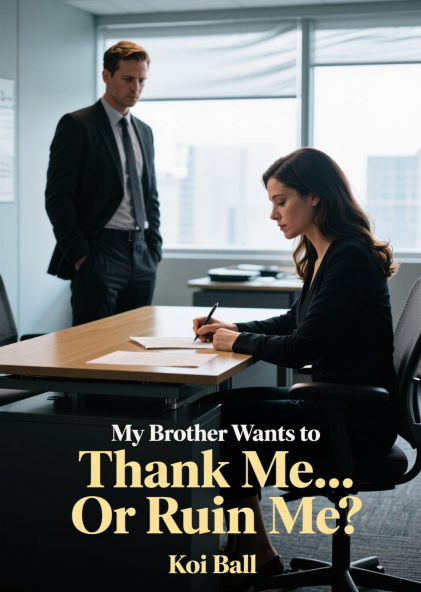
Daphne raised her little brother Oliver after their parents died, working in a factory at nineteen and later lending him every penny she had saved after her divorce. Now his company is profitable, and he calls out of the blue: he wants to transfer 30% of it to her name, paperwork already drawn up, all she has to do is sign.
Two impossible things happen at his office. Red text scrolls across her vision, warning that these are management shares, not dividend shares, and that signing will make her jointly liable for a $30 million debt that will take her home, her savings, and her daughter's school-district house. But when her hand touches Oliver's, she hears his thoughts: guilt, love, plans to pay off her mortgage with the dividends, and a house he has already put a down payment on, deeded in her name, next to her daughter's school.
A continuous excerpt shows the sharpest collision of evidence: a bank text flagging her property for legal seizure before she has signed anything, and Oliver dismissing it as a scam after a two-second glance. The page follows the collected chapters, which end at the moment Daphne decides one of the two signals must be a lie, without revealing which.
Excerpt — The Bank Text
The moment the pen touched the paper, my phone buzzed. It was a message from the bank.
"Dear customer, the property registered under your name at 42 Fairview Drive has been flagged for a pending legal seizure. If you have any questions, please contact…"
My blood ran cold at once. A pending legal seizure? My house?
But I hadn't even signed the agreement yet. How could there already be a legal claim against my property?
Unless someone had already registered my information under the company. Unless someone had already set everything in motion before I signed.
My head snapped up, and I looked at Oliver. He was staring down at his phone, so he was oblivious to my expression.
I quickly closed the message and forced myself to calm down.
No. It could be a scam. Fake bank texts were everywhere these days. Just last month, I'd gotten one claiming I'd won five million dollars.
One text wasn't enough to make me believe my brother was trying to hurt me. However, I couldn't pretend nothing had happened.
"Oliver," I called out, forcing my voice to stay steady. "I just got a text saying my house is under some kind of legal seizure. Do you know anything about it?"
I studied his reaction.
He looked up, frowning. "Huh? What seizure? Let me see."
I handed him my phone.
Oliver glanced at the screen for barely two seconds before chuckling. "Come on, Daphne. It's a scam text. Look at the number. It's clearly not the bank's official one. There are tons of scammers these days. Just ignore it."
I took the phone back and looked at the sender's number. Sure enough, it wasn't an official bank number. It was just an ordinary mobile number.
I let out a sigh of relief. It really was a scam.
"That scared me to death!"
I smiled and picked up the pen again.
Oliver smiled too. "You worry too much, Daphne. Come on. Sign it. Once you're done, I'll take you somewhere."
I nodded and lowered the pen toward the signature line once more. But then something struck me.
Oliver had said, "Look at the number. It's clearly not the bank's official one."
But he had barely glanced at it. How could he tell that fast?
Main Characters
Daphne is the narrator, a divorced mother raising her daughter Emma alone, who has spent the day picking up and setting down the same pen. Her ability to hear Oliver's thoughts through touch is presented as fact within the story, as are the red comments; the narrative never explains where either comes from.
Oliver Lawson is the younger brother she raised, warm and unhurried, offering coffee, appliances she once mentioned wanting online, and a share of his success. Adam is the contact whose texts push for a signature by a deadline set by someone called the boss, a detail that fits either a trap or a surprise depending on which signal Daphne trusts.
How the Story Begins
The first contradiction appears in the contract itself: a small-print clause making the transferee jointly liable for existing company debts, which Oliver waves away as boilerplate because, he says, the company has none. When Daphne invents an excuse to delay, he answers with tears and memories of her factory years, and his thoughts reveal the house surprise; a delivery of the exact kitchen appliances she once wished for online seems to confirm his sincerity.
Left alone, Daphne unlocks his phone with her own birthday and finds Adam's messages: a deadline pressure to get her signature, and instructions to show her the house the moment she signs. Later, Oliver produces a court filing showing his company as plaintiff chasing a supplier for 870 thousand dollars, the opposite of a debtor drowning in lawsuits. Each test she runs returns evidence for both stories at once.
Themes
The story is built as a duel between evidence systems. The red comments claim knowledge of hidden debts; the mind-reading claims access to hidden intentions; the contract, the texts, and the court filing can each be read to support either. The suspense comes not from missing information but from information that refuses to converge, and the reader is placed in the same position as Daphne: holding a pen over a document that is either a gift or a trap.
A second theme is affection as interference. Every time Daphne nearly decides, Oliver supplies a memory, a tear, or a thoughtful gift, and the history she has with him becomes the strongest argument against her own caution. The story treats love not as proof of safety but as the variable that makes verification hardest, which is why the smallest mechanical detail, a two-second glance at a phone number, ends up carrying more weight than thirty years of brotherhood.
Questions
Q: What exactly do the red comments warn about? A: They say the offered shares are management shares rather than dividend shares, that the company cannot pay its debts, and that signing would make Daphne jointly liable for 30 million dollars, putting her home, savings, and her daughter's school-district property at risk of seizure.
Q: Does the story reveal whether Oliver is sincere? A: Not within the collected chapters. The final scene has Daphne realizing that either the comments or Oliver's thoughts must be lying, and stating that she finally knows which, but the answer itself is not shown.